WHAT A REGISTERED EDITION IS.
Trading Card Gift Ideas3 min read
By John Birch, designer and founder
Turn over one of our cards and you will find a short line of letters and numbers beside a QR code. That line is the card's registered ID, and it is what makes the card an edition rather than a photo print. Type any ID into the registry and the card's page opens; everything that happens before the ID is printed is on how it's made.
A CARD WITHOUT A RECORD IS A PHOTO PRINT.
A trading card is a claim: this player, this season, this edition. A photo print makes no claim — it is just a nice picture. That is why every card we make carries its registered card ID on the back and opens its own page: the edition, the finish, the season, the stats and the date it was registered.
The rule behind it is simple: one registered edition per athlete, per finish, per season. There is no serial count on the printed cards themselves — the record is the registration. "Registered" means our own edition registry, not a copyright registration.
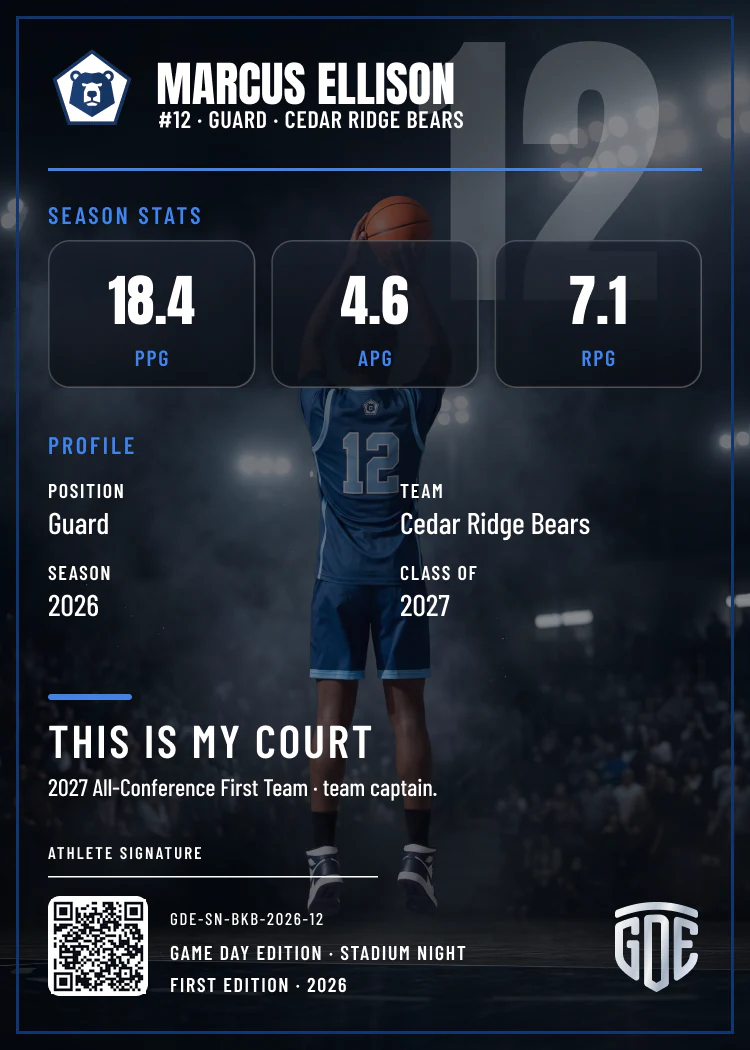
HOW TO READ THE ID.
The ID reads GDE-XX-XXX-YYYY-NN: our mark, then the style, the sport, the season and a two-digit number. In GDE-SN-BKB-2026-12, SN is the Stadium Night finish, BKB is basketball and 2026 is the season.
Because the rule is one edition per athlete, per finish, per season, a second finish for the same season is a second edition with its own ID. On a Senior Night card the ID sits beside SENIOR EDITION · 1 OF 1.
The same ID is printed on the certificate. If a QR code ever opens a page that says no card is registered, check the ID on the back of the card or on the certificate — mind O versus 0 and I versus 1.
WHAT THE QR CODE OPENS.
Scanning the QR code opens the card's page here. It shows the card turning over, front then back; the stats as the card prints them; and the edition record — the ID and the date it was registered — with one line on how the art was made: "Artwork generated with AI tools from the athlete's photos and finished by a person." Once the files are ready, the card front, the back and the flip video can be downloaded from the same page.
A customer's page is unlisted unless you choose to make it public: it opens only from the card's QR code or its exact ID, and search engines are asked not to index it.
You can open one right now: an example card page. Fictional athlete from our own roster — an example edition.
WHAT THE REGISTRY KEEPS.
Only what is printed on the card — the name as it appears, the team, the sport, the season, the finish and the stats you chose to print. Never the photos, never a home address, never a birthday. We never ask for a date of birth or a school name in the first place.
Want the page public, or taken down? Email hello@gamedayedition.com from the purchase address with the order number and the card ID. Takedowns are done within 48 hours; other changes within 30 days.
HOW LONG IT LASTS.
At least five years from the order. If the studio ever winds down, we keep the registry resolving for that period or tell you how to keep a copy. The domain is protected against transfer and renews on its own. The finished artwork is kept for 12 months so reprints stay possible; the record itself outlasts it.
Why it matters
Printed cards ship with a free printed Certificate of Authenticity carrying the same ID, and the digital card files include the certificate too — so the record travels with the card, on paper and online.
FREE PROOF FIRST. PAY IF YOU LOVE IT.
No payment now, no card details. You see the proof first.
- Never posted without your OK
- Deleted after delivery, on a schedule you can see
- Parent/guardian consent required